Every talk I have given that has a recording, newest first. Each one links to its slides, demo code, and the event it was given at.

For anything that has not made it here yet, there is also a YouTube playlist.


Instrument Go Without Changing a Single Line
Talks · · 2 min

talk: Instrument Go Without Changing a Single Line

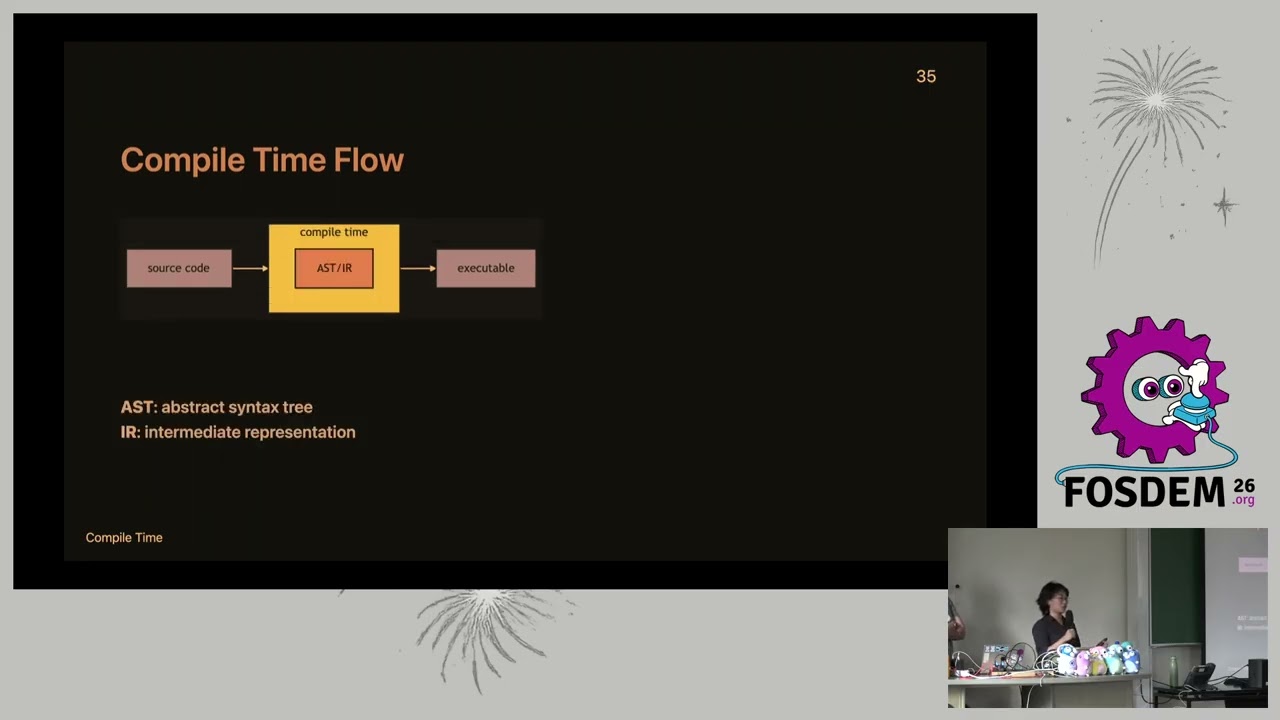
The debugging loop is slow. You cannot reproduce the bug locally, so you add a log line and redeploy. Wrong place. You do it again. An agent alone does not fix this: it still has to pick a mechanism, and it has to know what that mechanism costs. This talk is about three open-source approaches that take the rebuild out of that loop. Each acts at a different point in the software lifecycle, and each inherits the strengths and constraints of its intervention point. ...
August 13, 2026 · 2 min · 293 words · Kemal Akkoyun
Why Your Go Benchmarks Are Lying
Talks · · 2 min

talk: Why Your Go Benchmarks Are Lying

A benchmark is a measurement system. It can report a precise number while measuring removed work, an unstable sample, or an uncontrolled machine. This talk argues you should trust a Go benchmark only after answering three questions: Is the compiler measuring real work? Is the sample stable enough? Is the difference large relative to the noise? We work through three layers. Compiler honesty covers dead-code elimination, sinks, constant folding, inlining, timer ordering, and the B.Loop construct that fixes the non-terminating-timer case. Statistical interpretation covers repeated samples, benchstat, coefficient of variation, run-count discipline, and the p-hacking traps that inflate false positives. Environment control covers both local machines and CI: Linux frequency and isolation controls, perflock, benchdiff, and the bare-metal runners that shared CI instances are not. ...

August 12, 2026 · 2 min · 228 words · Kemal Akkoyun
How to Instrument Go Without Changing a Single Line of Code
Talks · · 1 min

talk: How to Instrument Go Without Changing a Single Line of Code

Zero-touch observability for Go is finally becoming real. In this talk, we walk through the different strategies you can use to instrument Go applications without changing a single line of code, and what they cost you in terms of overhead, stability, and security. We compare several concrete approaches and projects: eBPF-based auto-instrumentation using OpenTelemetry’s Go auto-instrumentation agent and OBI (OpenTelemetry eBPF Instrumentation), compile-time manipulation using tools like Orchestrion and the OpenTelemetry Compile-Time Instrumentation SIG, runtime injection via Frida/ptrace, and USDT (User Statically-Defined Tracing) probes — both via libstapsdt and a custom Go runtime fork. ...

February 1, 2026 · 1 min · 204 words · Kemal Akkoyun
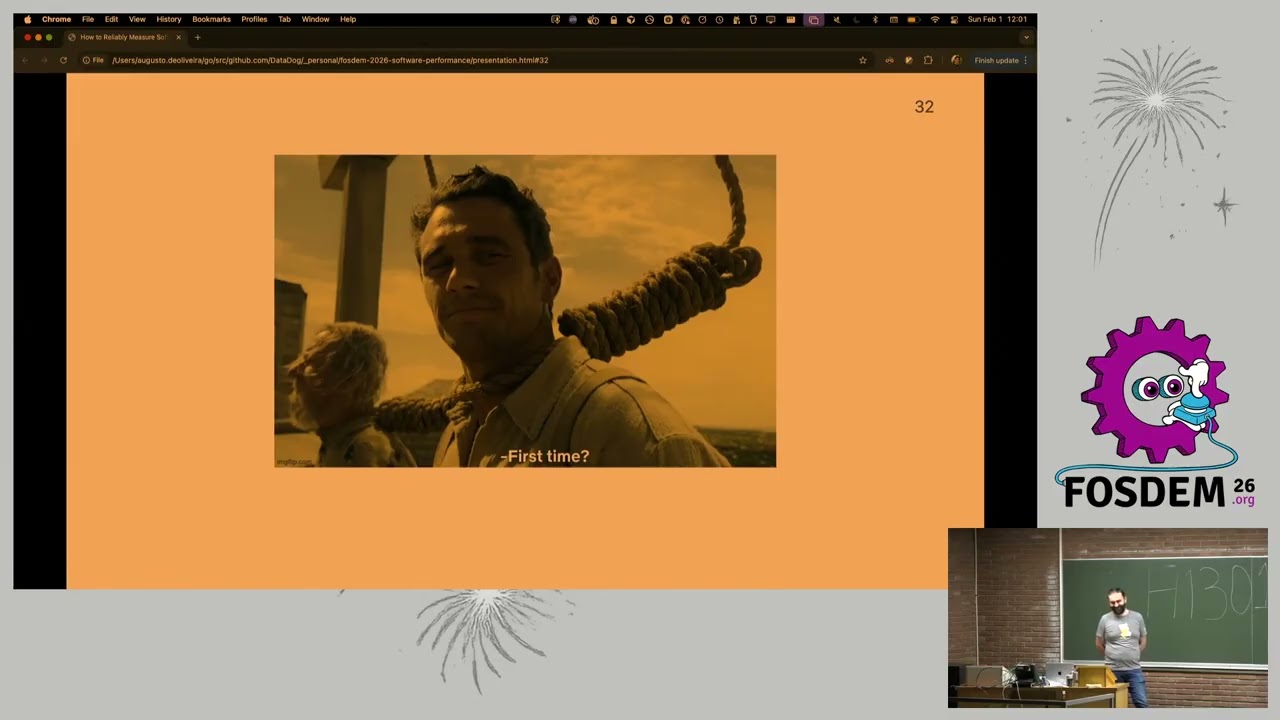
How to Reliably Measure Software Performance
Talks · · 1 min

talk: How to Reliably Measure Software Performance

Measuring software performance reliably is remarkably difficult. It’s a specialized version of a more general problem: trying to find a signal in a world full of noise. A benchmark that reports a 5% improvement might just be measuring thermal throttling, noisy neighbors, or the phase of the moon. In this talk, we walk through the full stack of reliable performance measurement — from controlling your benchmarking environment (bare metal instances, CPU affinity, disabling SMT and dynamic frequency scaling) to designing benchmarks that are both representative and repeatable. We cover the statistical methods needed to interpret results correctly (hypothesis testing, change point detection) and show how to integrate continuous benchmarking into development workflows so regressions are caught before they reach production. ...

February 1, 2026 · 1 min · 209 words · Kemal Akkoyun
Unleashing the Go Toolchain
Talks · · 1 min

talk: Unleashing the Go Toolchain

The -toolexec flag hides a super-power in the Go toolchain: it lets you turn every go build into a programmable pipeline. In this session we’ll reveal how a simple wrapper command can inject custom analysis, code generation, and instrumentation—without changing a line of application code. You’ll see how platform and tooling teams use -toolexec to weave organisation-wide practices directly into the build, from enforcing error-handling standards to automatically adding observability hooks. We’ll map the journey from a “hello-world” wrapper to full Aspect-Oriented compile-time transformations, and discuss the trade-offs that come with this new power. ...

August 14, 2025 · 1 min · 187 words · Kemal Akkoyun