Engineering · · 8 min

otelc: zero-touch Go traces at compile time

We’re going to instrument a Go program without touching its source, and the whole change fits in one build command. Here’s the before and after: 1 2 go build -o myapp . otelc go build -o myapp . Same flags, same package, one extra word in front. The binary that comes out has OpenTelemetry instrumentation compiled in for the libraries otelc knows about, net/http and gRPC among them, and nobody opened a handler file. ...
July 16, 2026 · 8 min · 1632 words · Kemal Akkoyun
Engineering · · 8 min

Why Go can't be monkey-patched (and what people do about it)

Start a Java service with one extra flag and it gets traced, with no source change and no rebuild: 1 java -javaagent:agent.jar -jar app.jar The JVM offers each class’s bytes to the agent’s ClassFileTransformer before it defines the class, so the agent can rewrite a method on its way in. Python lets you swap a method at runtime, which is the monkey-patching of the title. That flag is Java’s agent slot, and Python doesn’t even need one. Go has no such slot, and that follows from how Go was designed. ...

July 2, 2026 · 8 min · 1595 words · Kemal Akkoyun
Auto-Instrumenting Go
Engineering · · 12 min

Auto-Instrumenting Go: From eBPF to USDT Probes

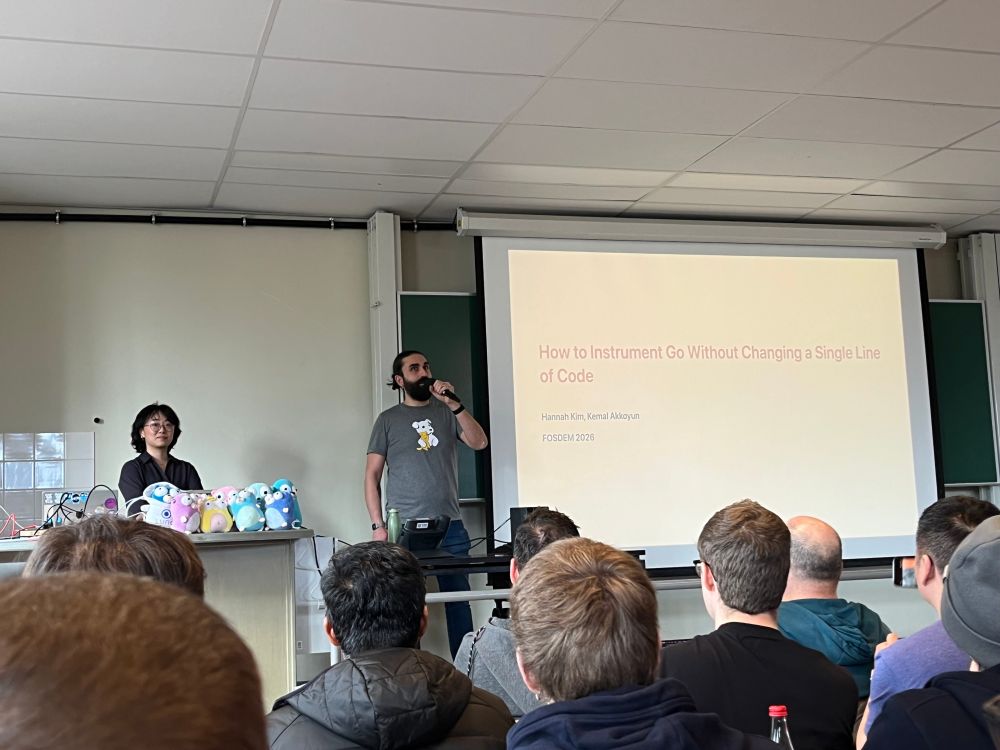
This post expands on the FOSDEM 2026 Go Devroom talk I co-presented with Hannah S. Kim. The talk, demo code, and all benchmark scenarios are available in the fosdem-2026 repository. The Problem Go is one of the best languages for building production backend services. It compiles to native binaries, has excellent concurrency primitives, and produces predictable performance characteristics. But when it comes to auto-instrumentation — adding observability without modifying source code — Go is uniquely difficult. ...

February 27, 2026 · 12 min · 2522 words · Kemal Akkoyun