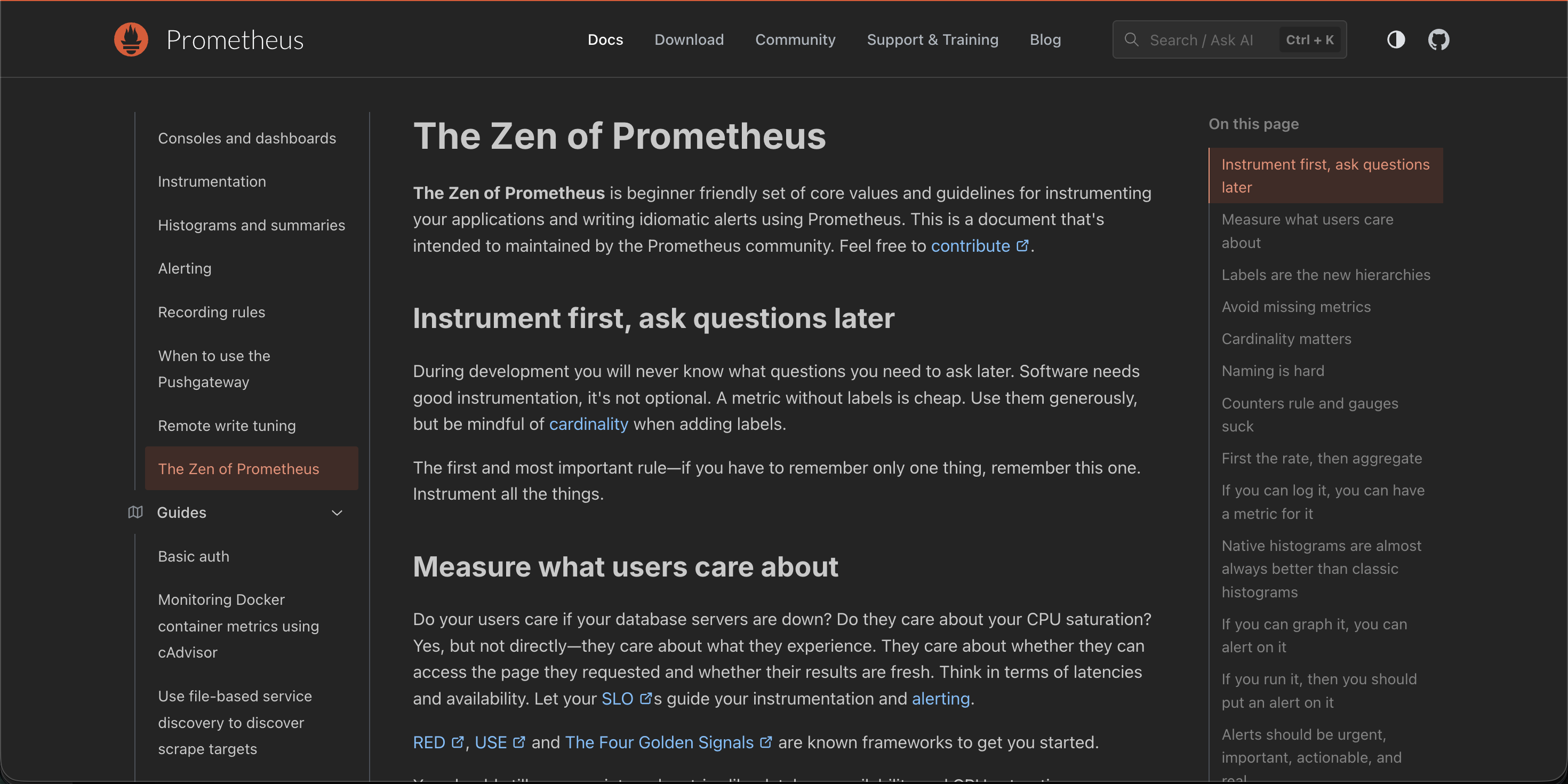
Every now and then a project surprises you by remembering something you said years ago. This week was one of those weeks. A talk I gave at PromCon Online 2020 — The Zen of Prometheus — has quietly become part of the official Prometheus documentation.
I am still sitting with it.
Where it started
The talk was born in the strangest year of my career. PromCon 2020 was online, like everything else. I was a few years deep into running Prometheus in anger, collecting scars from instrumenting services that didn’t want to be instrumented and writing alerts that kept me up at night for the wrong reasons. I wanted a way to package those lessons that wasn’t another forty-slide deck of bullet points.
I borrowed a frame from somewhere I love: PEP 20, The Zen of Python, the small, almost-koan list that has shaped how an entire community talks to itself. Beautiful is better than ugly. Simple is better than complex. I wondered if the same shape could carry the lessons we keep relearning about metrics, instrumentation, and alerting. The result was The Zen of Prometheus: a handful of aphorisms, a companion site, some slides, and a recording for anyone who wanted to follow along.
I thought it would live the typical conference-talk life: watched a few times, cited in a Slack thread, then politely forgotten.
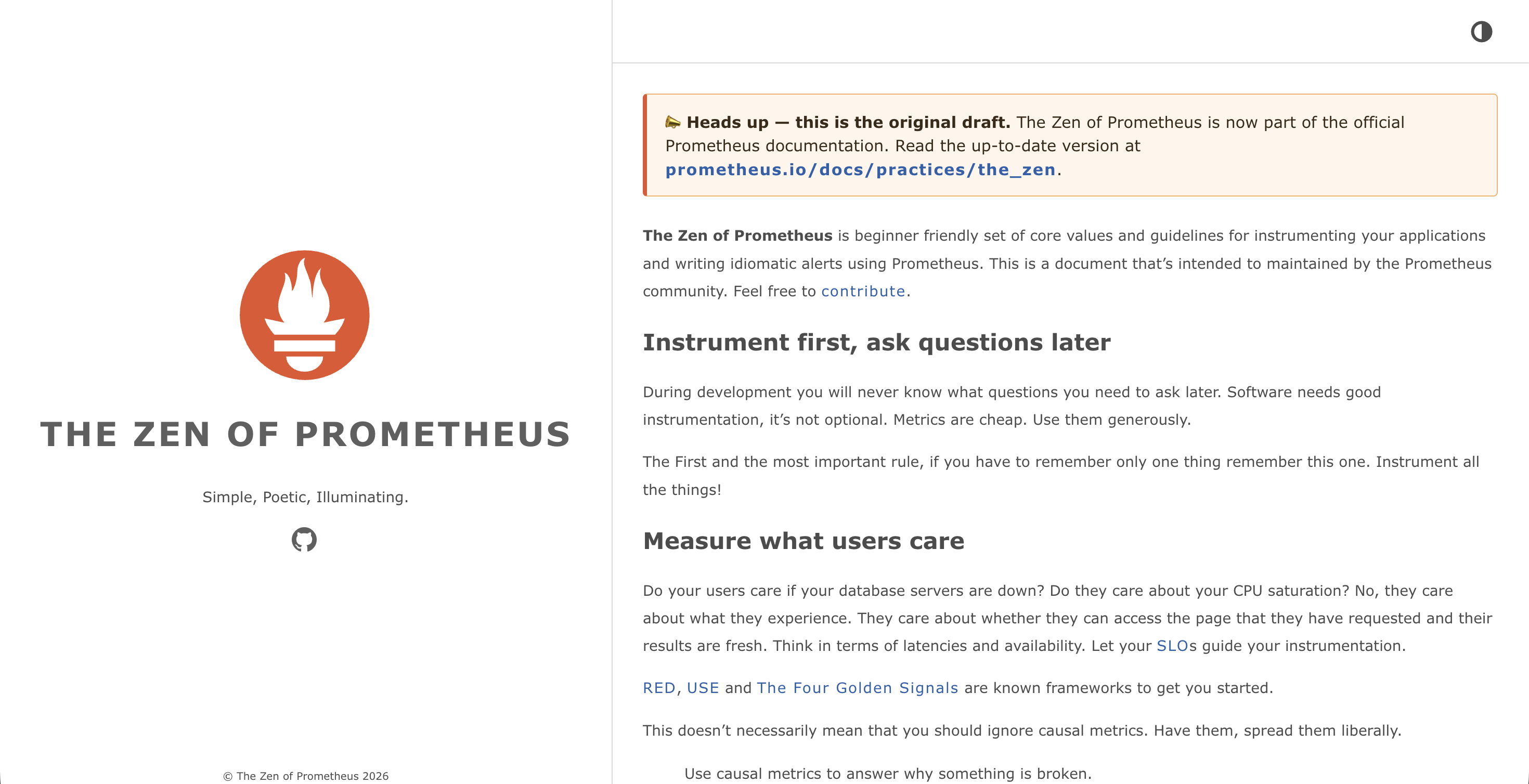
What it became
It didn’t get forgotten. Other people kept linking to it and kept finding it useful — and now it has a home in the official Prometheus docs.
That word, home, is the one that keeps coming back to me. A talk is a moment. A docs page is a place. When something moves from the first into the second, it stops being Kemal’s slides from a 2020 PromCon and becomes something a newcomer reads on day one without ever needing to know who wrote it. That is exactly what I would have wanted, and I’m not sure I would have had the nerve to ask for it.
I won’t reproduce the principles here. They live on the official page now, and that’s where they should be read, alongside the rest of the practices, maintained by people whose role is to keep them honest as the project evolves.
Looking back
The version of me that wrote those lines was not trying to be authoritative. He was trying to write down enough hard-won lessons that the next person would not have to learn them at three in the morning. Most of what ended up in The Zen of Prometheus came from mistakes (mine, and the teams I worked with), and from the slow realisation that good instrumentation is a discipline of restraint.
It’s a strange and quietly emotional thing to see those notes outlast the moment they were written for. The talk was a small gesture. The fact that it found its way into the docs says less about the talk and more about the Prometheus community: a project still willing to listen to its users, fold their field notes back into its canon, and treat best practices as a living document rather than a finished one. That’s rare, and it’s why I keep coming back to this project.
Thanks
Thank you to the Prometheus maintainers, who steward the project and keep its documentation alive enough that community contributions can grow into something canonical. A special thanks to @beorn7 for the careful reviews on the docs PR that brought The Zen in. Thank you to everyone who asked sharp questions about the talk over the years and pushed back where I was wrong. A particular nod to @jessicalins, my partner in crime on the follow-up at PromCon EU 2022, who carried the same thread further with me and made it sharper than I could have alone.
A talk only ever belongs to its speaker for an hour. After that, it belongs to whoever finds it useful.
Read it, improve it
If you have not yet, read the page. And if your own production scars suggest a principle that is missing, propose it. The docs are alive. Same team, different companies — and the canon gets better when more of us write into it.